8 Best Group Coaching and Cohort Platforms for Corporate L&D in 2026 [By Delivery Method]
Quick Summary
The right group coaching platform depends on how development is delivered, how structured the program needs to be, and whether it is human-led, AI-supported, or self-managed. Enterprise teams should also consider facilitator access, scheduling, feedback, progress tracking, and scalability. Here are our top three corporate group coaching software picks:
Why Most Group Coaching Programs Go Generic
Enterprise L&D teams rarely struggle to put people into a cohort. The harder part is making sure everyone in that group shares a development need specific enough to benefit from learning together.
That's where group coaching platforms start to separate. A program can scale quickly and still become generic if the cohort is too broad, the facilitator lacks the right context, or progress gets measured only through attendance and completion.
For L&D leaders, the real decision is how to close shared capability gaps across the workforce without losing relevance as programs scale.
If your team is building cohorts without a clear skill gap tying them together, or can't point to what changed once the program wrapped, it's worth seeing how these eight platforms differ.
Why Listen To Us
Growthspace works directly with enterprise L&D teams at companies including Microsoft, Deloitte, EY, Siemens, PayPal, and Tim Hortons. Our programs report a 30% increase in internal promotions within 12 months and a 96% engagement rate among participants. That gives us firsthand visibility into what makes group development work at scale, from expert fit to measurable business impact.
We used that lens to assess each platform on delivery model, coaching approach, enterprise readiness, and practical fit for L&D teams. All the information is sourced from public platforms, where each vendor on the list earns its place based on a specific use case rather than ranking by brand size alone.
How Group Learning and Development Works for L&D Teams
Group learning and development connects employees who share a skill, role, or business challenge in a structured development experience. Where it gets more complicated for L&D teams is deciding how to deliver that development. This is a critical consideration since the delivery model affects everything from the level of human involvement to how easily a program can scale.
Four delivery models cover most of the group employee coaching platform in this market:
There is no single right model. Each one suits a different type of development need, scale, and level of human involvement.
Why Team-based Coaching Works Better for Shared Skill Gaps
Team-based coaching works best when several employees need to build the same capability simultaneously. Instead of developing each person separately, L&D teams can run a single structured program and build the skill across a whole cohort.
- Shared language across the team: When a cohort learns the same framework together, the skill is easier to apply consistently across the team rather than being picked up differently by each person.
- Peer learning grounded in real work: Participants bring in real-world situations from their own jobs, not hypothetical case studies, and see how peers facing the same challenge handle it.
- Reach without losing the room: One coach or facilitator can work with a cohort at once, covering more people than separate 1:1 programs do without sacrificing live discussion and feedback.
- A cohort-level view of progress: The right group coaching software tracks the group from start to finish, giving L&D leaders a clearer before-and-after view instead of a completion checkbox.
8 Best Group Coaching Software for Corporate L&D Compared
We compared the leading options based on delivery method, coach type, and how each online group coaching platform handles cohort-based development so that you can shortlist faster:
1. Growthspace
Best for: Precision, skill-specific group development with expert facilitators
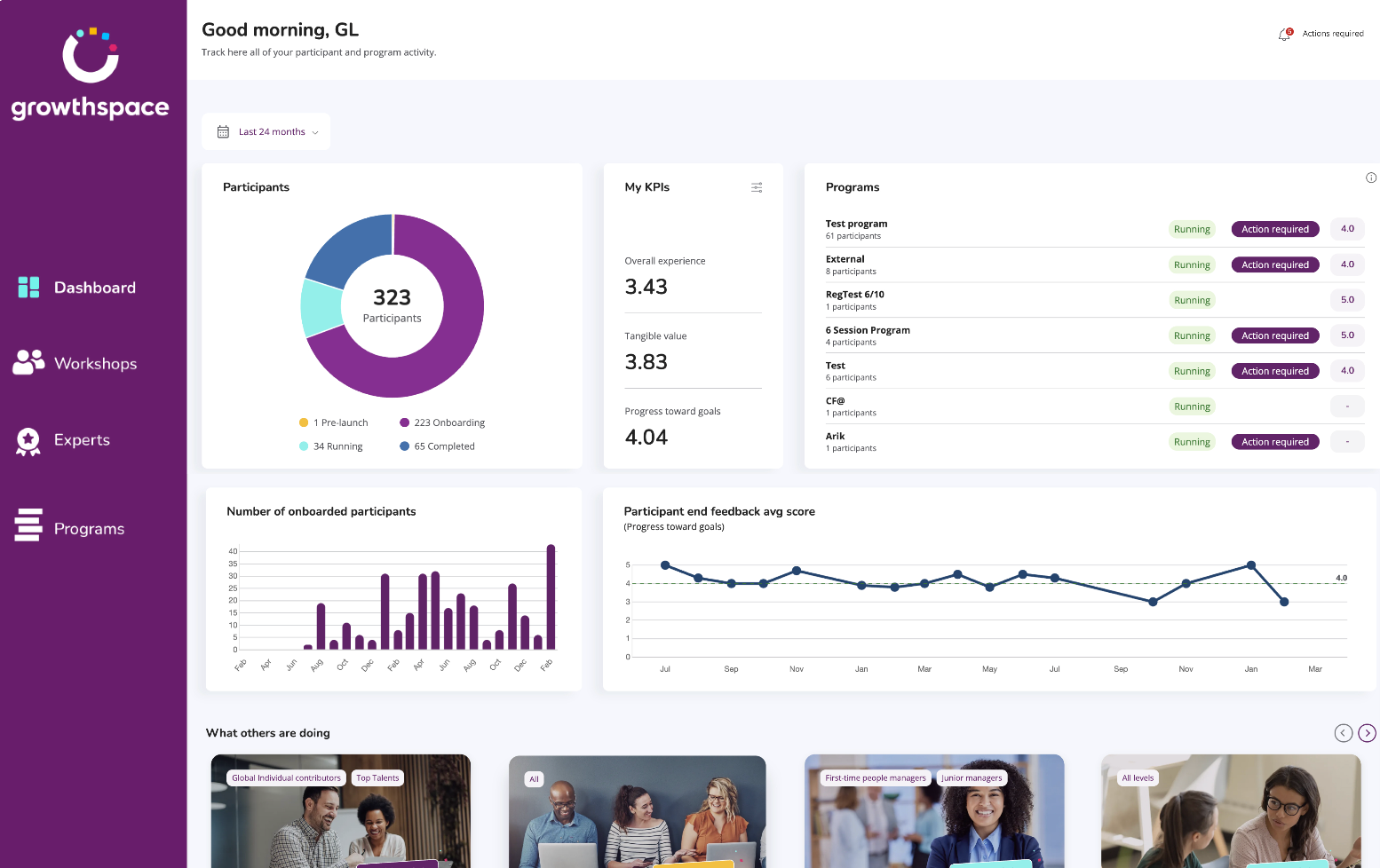
Growthspace is a precision skill development platform for enterprise L&D teams, covering a wide range of group coaching formats from manager training to cross-functional skill gaps. Rather than assigning learners to broad coaching programs, teams start by identifying the skill gap, then build the program around that specific skill.
For cohort-based development, Growthspace groups three to six employees around a shared development goal and matches them with an expert facilitator. Its AI weighs function, seniority, industry, geography, and the target capability to find the right fit.
The target capability is drawn from a defined taxonomy of topics spanning leadership, management, communication, cross-functional challenges, and more. Each program runs as four focused 1.5-hour sessions designed around the situations employees face in their roles.
Participants practice new behaviors, compare approaches with peers, and build a shared language around the skill as they go. Growthspace’s group programs report a 30% increase in internal promotions within 12 months, and 96% of participants say the sessions helped them meet their development goals.
The delivery model is hybrid. AI supports matching, skill-gap assessment, and program measurement, while a human expert leads every live session. Growthspace draws from a network of 2,500+ vetted experts, giving L&D teams a broad pool of practitioners to match to different development needs.
Group programs can also stack with 1:1 development and expert-led workshops. L&D teams can move between individual, small-group, and wider group formats depending on how specific the development need is and how many employees share it.
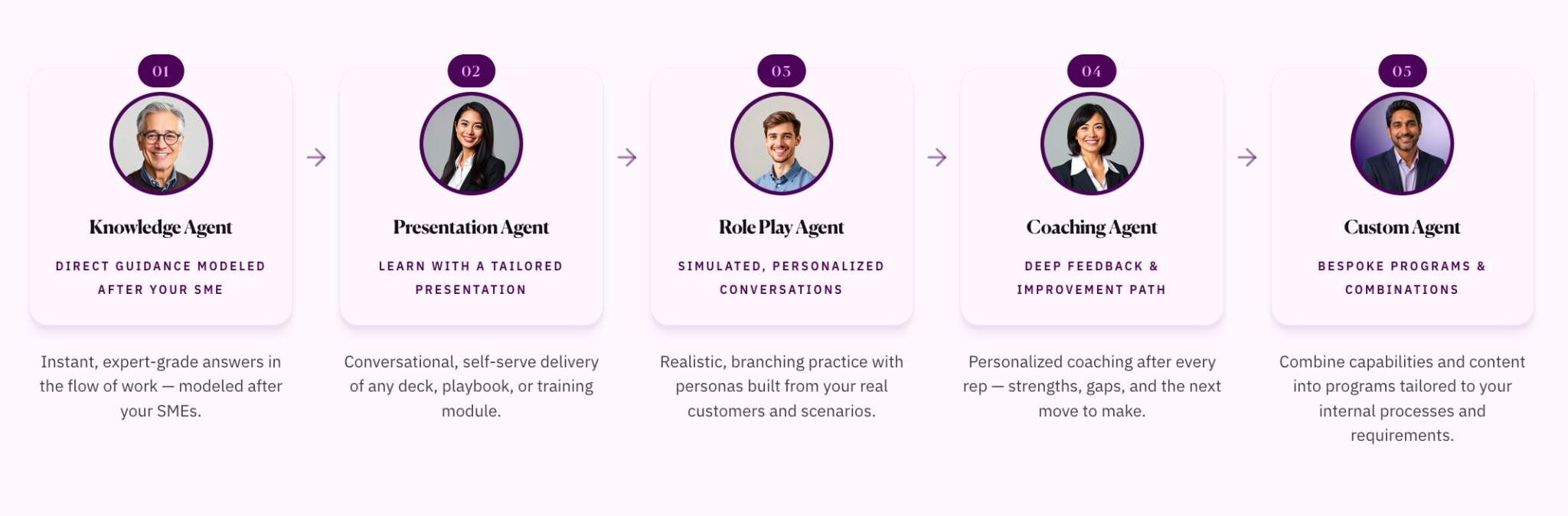
For organizations that want to scale internal expertise, ExpertX adds a separate AI layer. It models approved internal knowledge and subject-matter expertise into AI agents employees can use for Q&A, role-play, and guided learning. The agents answer only from approved organizational content and defer to a human when the information is unavailable.
Key Features
- Coach network: External experts lead 1:1 development, Group Skill Development, and workshops. ExpertX separately models in-house subject-matter experts into AI agents for ongoing learning.
- Automated scheduling: Supports global expert matching and scheduling across multiple regions and time zones.
- Resource repository: ExpertX provides employees with access to approved internal knowledge and training content via AI-powered Q&A, role-play, and guided learning.
- Engagement and feedback: Track engagement metrics, collect anonymous participant feedback, and measure program performance across cohorts.
- Goal and progress management: Every program starts with defined skill goals, measured against outcomes like promotion rates, 360 feedback scores, and functional business metrics.
- Enterprise readiness: Supports SSO authentication and enterprise deployments for large organizations.
Pros
- AI-based expert matching helps cohorts work with practitioners relevant to their actual skill gaps
- Small cohorts of three to six give participants more room for practice, feedback, and peer learning
- A focused four-session format keeps time investment low without sacrificing depth, unlike lengthier programs that struggle to hold busy teams' attention
- Multiple delivery formats make it easier to scale development across different teams and needs
- Goal and progress tracking gives L&D teams clearer evidence of how programs are performing
- A large global expert network makes it easier to find relevant expertise across roles, industries, and regions
Cons
- Built primarily for enterprise L&D teams rather than smaller companies with lightweight coaching needs
Why We Picked This
We picked Growthspace because it solves the exact problem this list opened with: cohorts that don't tie back to a shared skill gap. The AI matches cohorts around one shared skill gap, not a generic curriculum, so every session ties directly back to what the team actually needs.
Growthspace also covers more ground than most platforms on this list. Group cohorts get a live human expert for shared skill-building. Meanwhile, ExpertX adds a second layer: separate, always-on access to the organization's own internal SMEs for guidance beyond external sessions.
What customers are saying
Growthspace's customer stories highlight how promptly employees apply what they learn. Marcela Pineda, Director of Global Talent Development at TELUS Digital, described it this way:
"Our leaders didn't just learn—they applied it immediately. That's why they kept coming back asking for more."
Customers also point to real business impact after the program ends. Tyrelle McKoy, HR Manager at Tim Hortons, noted:
"We've seen a lot of positive results with our leaders, especially coming out of Growthspace. Productivity levels have increased, especially in the months post-program."
These same themes show up in G2 reviews. As of August 2026, Growthspace has an overall rating of 4.8/5 based on 249 reviews.
Pricing
Growthspace offers custom pricing based on the number of participants, program type, and implementation requirements.
2. BetterUp
Best for: Broad workforce behavioral development at enterprise scale
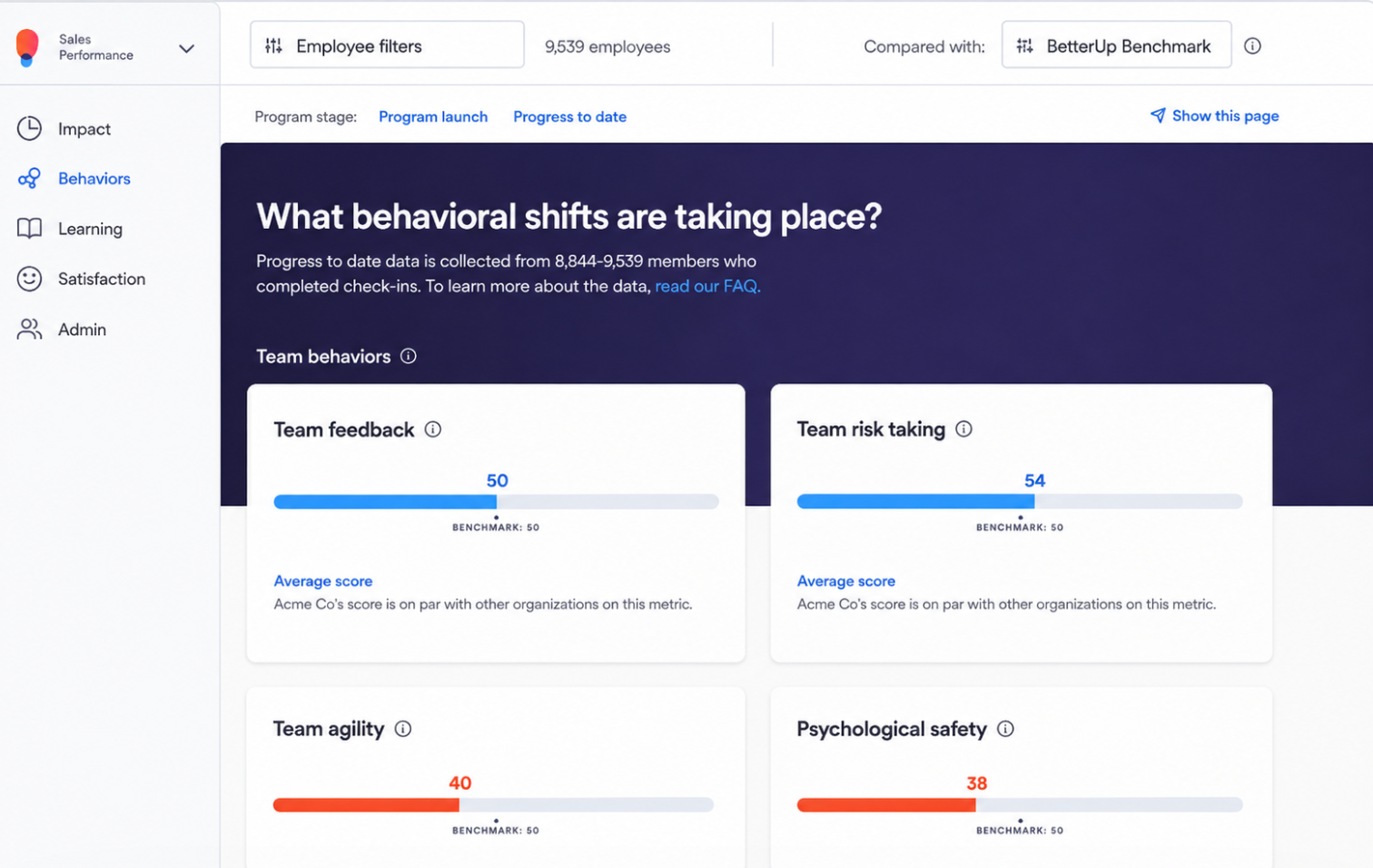
BetterUp is an enterprise coaching platform focused on long-term employee development across areas such as leadership, resilience, self-awareness, well-being, and performance. Members begin with an assessment that covers 25 behavioral dimensions, helping shape the coaching focus from the start.
That breadth makes it useful for workforce-wide development, but less specialized for L&D teams trying to build the same specific capability across a defined cohort.
Key Features
- Whole Person Assessment: Measures 25 dimensions across mindsets, behaviors, and outcomes to identify strengths and development areas.
- 360 feedback: Collects feedback from managers, peers, and direct reports to surface differences between self-perception and how others experience a leader.
- Reflection Points: Reassesses Whole Person skills during the coaching journey so employees can see how their strengths and development areas change over time.
Pros
- Strong fit for workforce-wide behavioral development
- Broad geographic coach network supports distributed workforces
- Built-in assessments support ongoing self-reflection and development
Cons
- Less specialized for narrow, skill-specific cohort development
- Preferred coach availability may not always align with an employee’s schedule, language, or location
Why We Picked This
We picked BetterUp for organizations looking to run broader behavioral and leadership development across the workforce. Its coaching model covers areas like resilience, wellbeing, communication, and performance.
Pricing
BetterUp offers two subscription plans (Plus and Premium) with custom pricing.
3. CoachHub
Best for: Multilingual coaching deployment across distributed workforces
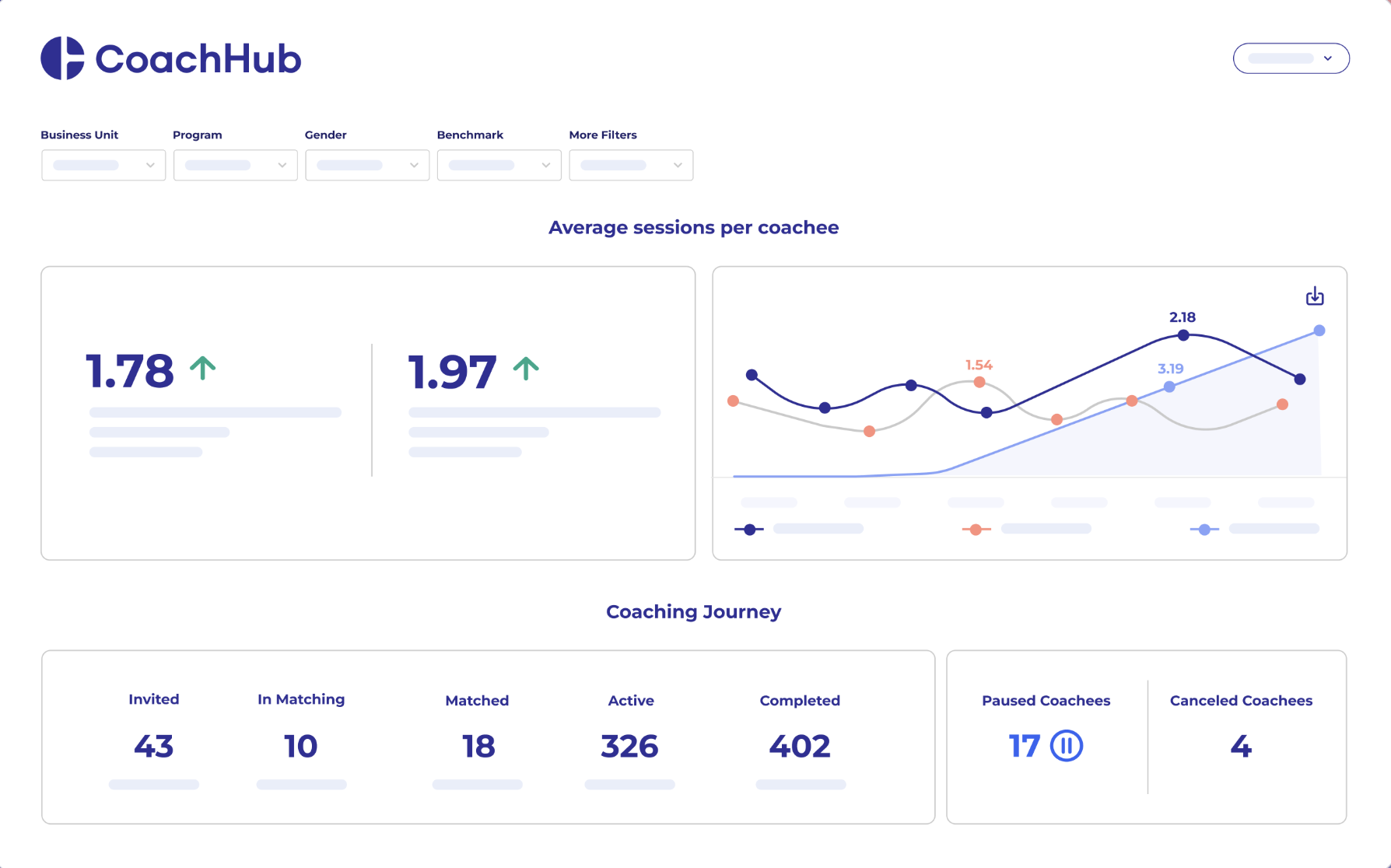
CoachHub is a digital coaching platform built for organizations running development across multilingual, geographically distributed teams. Coaching is available in more than 80 languages, making the platform useful for employees across regions who need access in their preferred language.
Beyond live coaching, CoachHub adds learning resources and multi-source feedback to support development between sessions.
Key Features
- CoachHub Academy: Gives employees access to thousands of development resources between coaching sessions.
- Multi-source feedback: Collects input from managers, peers, and direct reports around development priorities.
- Enterprise integrations: Connects with platforms like Microsoft Teams, Workday, and SAP.
Pros
- Integrates with common HR and collaboration systems
- Learning resources extend development beyond live coaching sessions
- Multi-source feedback adds perspectives from different workplace relationships
Cons
- Much of the platform's learning experience depends on CoachHub Academy and digital resources, meaning some coaching value comes from self-directed content rather than live sessions
- Public customer review volume remains very limited
Why We Picked This
CoachHub earns a place on this list for organizations running coaching across multilingual, globally distributed teams. Its language coverage and enterprise integrations make it a practical fit for international deployments.
Pricing
CoachHub provides custom pricing based on program requirements.
4. Torch
Best for: Leadership coaching tied to organizational transformation and 360° feedback
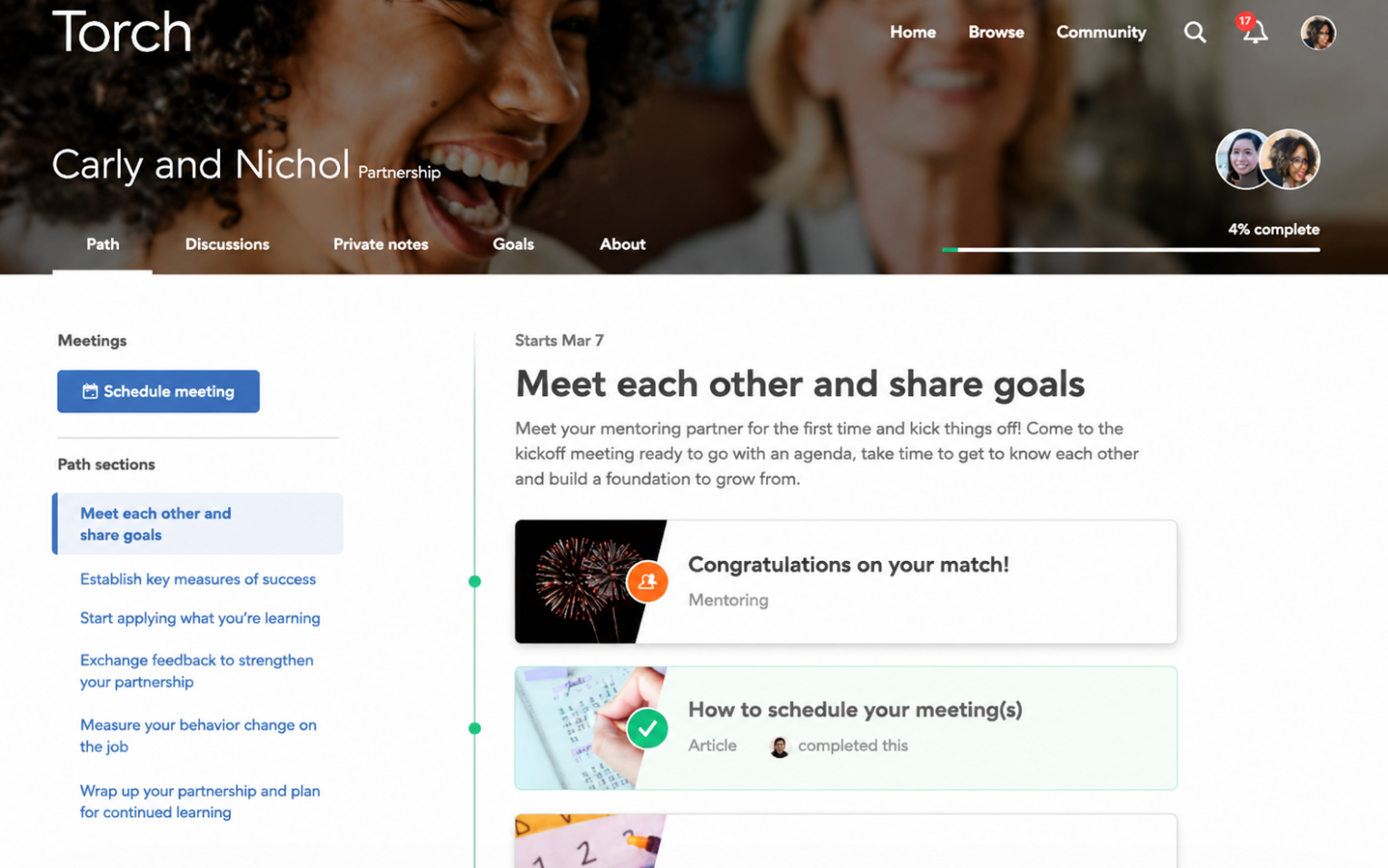
Torch is a leadership coaching platform that connects development to the leadership priorities an organization sets for itself. Programs can be mapped to company-defined leadership capacities, while 360° feedback gives participants input from managers and colleagues at the start of the coaching journey.
The platform also includes Spark, an AI coaching agent add-on employees can use between live sessions to work through challenges, practice conversations, and prepare for real workplace situations.
Key Features
- 360° feedback: Collects qualitative input from managers, peers, direct reports, and other colleagues around selected leadership capacities.
- 360 Impact: Revisits feedback near the end of live coaching to show how leadership behaviors have changed over the engagement.
- Manager alignment meetings: Bring the employee, coach, and manager together early in the program to connect coaching priorities with workplace expectations.
Pros
- Combining outside coaching with internal mentoring in one place means managing one vendor instead of two
- Strong tie between coaching and actual leadership goals
- 360-degree tracking gives a clearer read on real behavior change, not just attendance
Cons
- Maintaining user engagement can be challenging over time
- Setup takes longer for companies that haven't already mapped their leadership capacities.
Why We Picked This
Torch earns its spot for tying coaching directly to company-defined leadership priorities, supported by mentoring and 360° feedback. It’s a good fit for organizations using coaching to support leadership change rather than general skill development.
Pricing
Custom, per seat per year.
5. Coachello
Best for: Coaching workflows embedded in Microsoft Teams and Slack
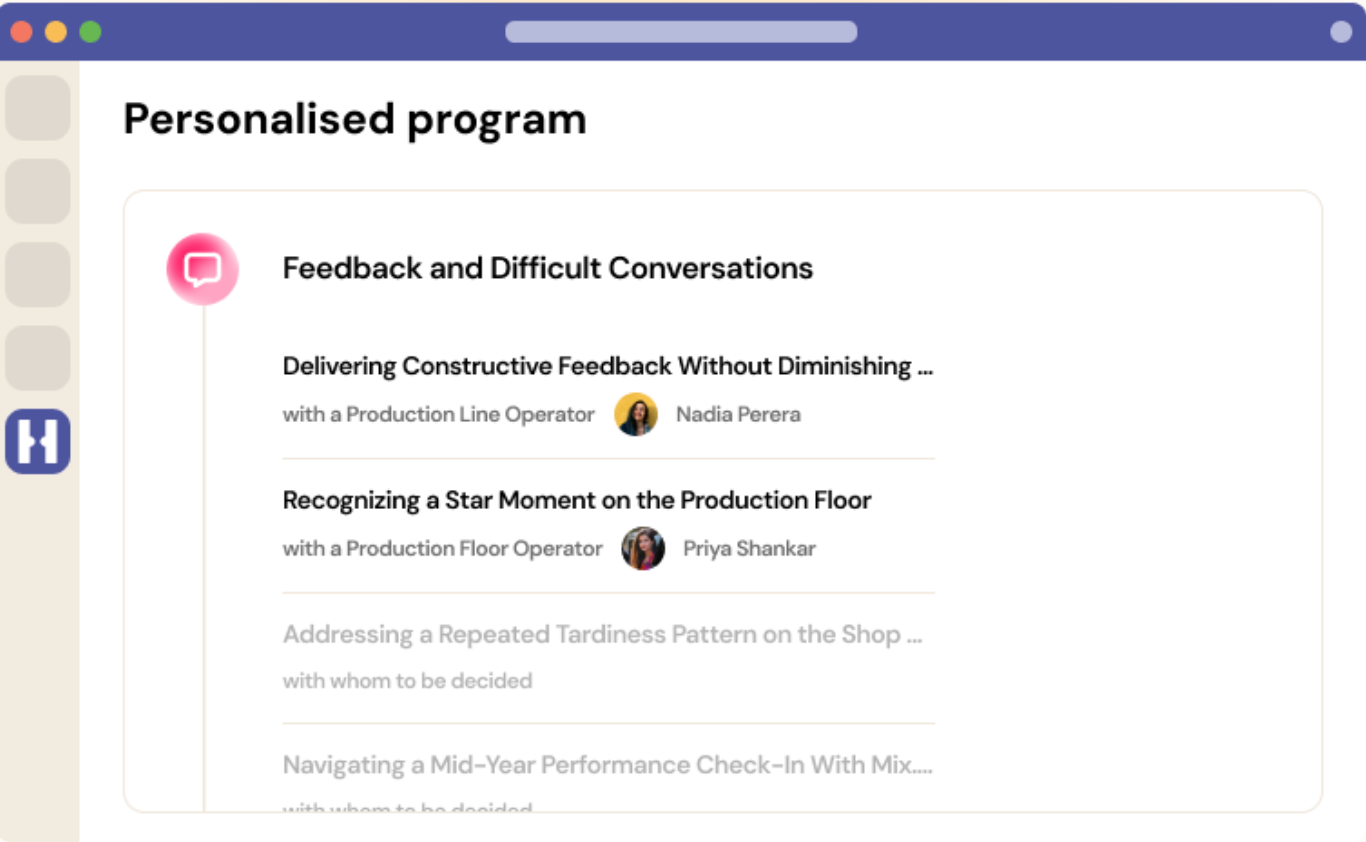
Coachello is an upskilling platform that brings coaching and soft-skill practice into Microsoft Teams and Slack. Employees can access human coaching, AI support, and role-play exercises without leaving their current learning environment.
The platform combines ICF-certified coaches with AI-powered practice between sessions. Employees can rehearse conversations like feedback, conflict, and stakeholder discussions, while HR and L&D teams gain aggregated visibility into engagement and common skill gaps.
Key Features
- AI role-plays: Let employees practice workplace conversations like feedback, conflict, and stakeholder management in a simulated environment.
- In-workflow access: Coaching, bookings, and development activities are available inside Microsoft Teams and Slack.
- Internal Coaches: Organizations can run their own internal coach pool through the platform, alongside external coaches
Pros
- Keeps development inside collaboration tools employees already use
- Gives employees a private space to practice difficult workplace conversations
- Useful for first-time managers preparing for feedback, conflict, and stakeholder conversations
Cons
- AI avatars can occasionally lag during role-play sessions
- Some AI coaching questions may feel repetitive over time
- Learning sessions feel lengthy for employees with limited time
Why We Picked This
Coachello’s personalized coaching and AI role-play make it a useful option for teams that want development inside Microsoft Teams or Slack.
Pricing
Coachello provides custom pricing based on organizational requirements.
6. Teachfloor
Best for: Structured peer activities and between-session cohort engagement
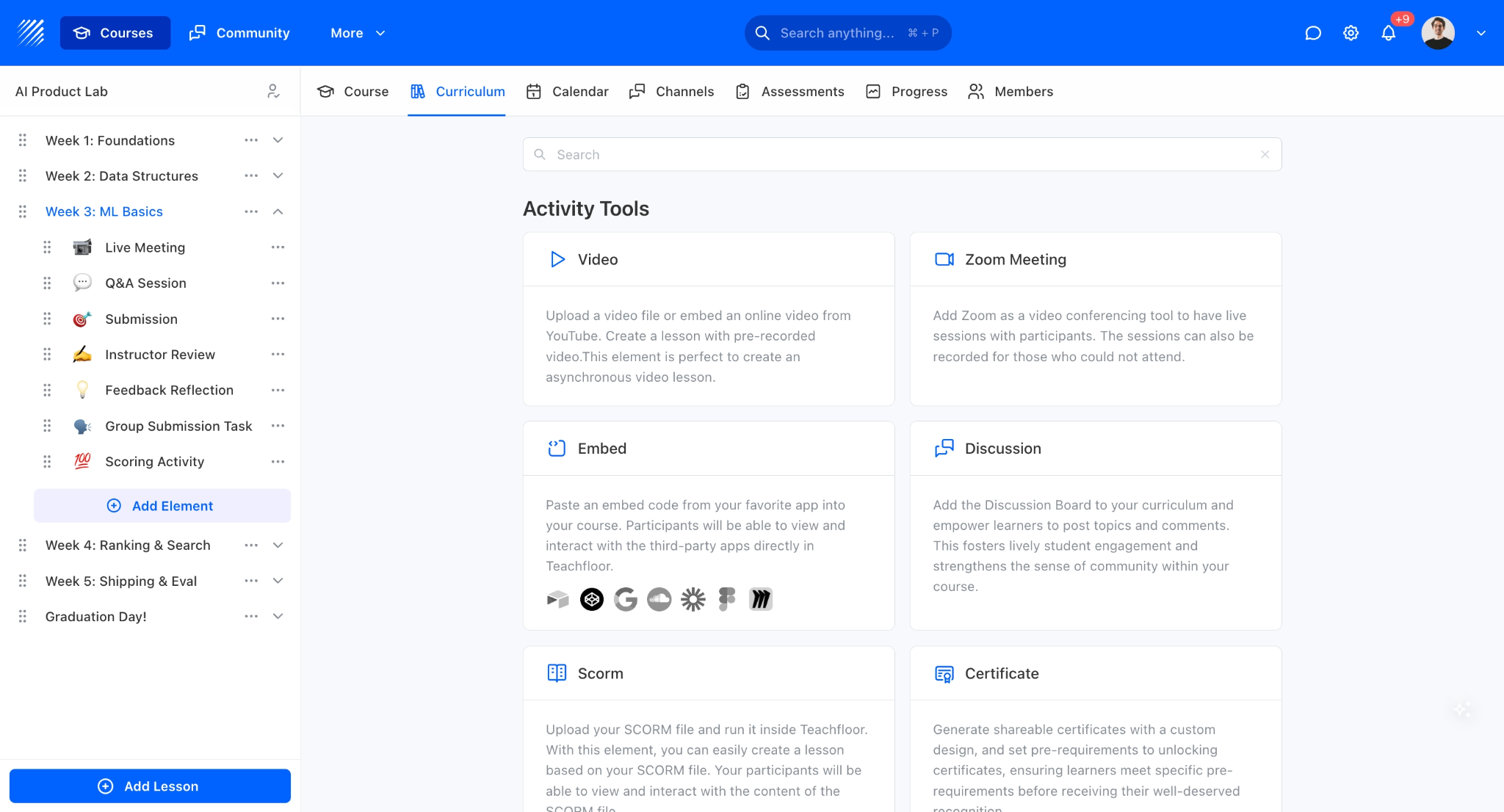
Teachfloor gives L&D teams the infrastructure to run learning programs with their own instructors or facilitators. The platform supports live sessions, assignments, peer activities, discussion spaces, and learner progress tracking across the program. Programs can combine scheduled sessions with self-paced content and collaborative activities between meetings.
Key Features
- Flexible delivery: Combines live sessions, self-paced content, assignments, and collaborative activities within the same program.
- Assignments and activities: Lets instructors add projects, exercises, and peer-based tasks throughout the learning journey.
- Progress tracking: Tracks learner participation, activity completion, and progress across programs.
Pros
- Rubric-based peer review keeps learner feedback structured
- Community spaces support discussion between scheduled sessions
- Live and asynchronous activities can be combined within the same program
Cons
- Organizations need to provide their own instructors or facilitators
- Course organization can feel limited without tagging options
Why We Picked This
If having a built-in facilitator network is not a priority, Teachfloor is a practical option for teams running programs with their own instructors. Its peer-review and community tools are particularly useful when learner interaction needs to continue between sessions.
Pricing
Teachfloor starts at $89/month for up to 50 users. Higher-tier plans add capabilities like SSO, white-label branding, and advanced integrations.
7. Docebo
Best for: Multi-audience learning administration and enterprise training operations
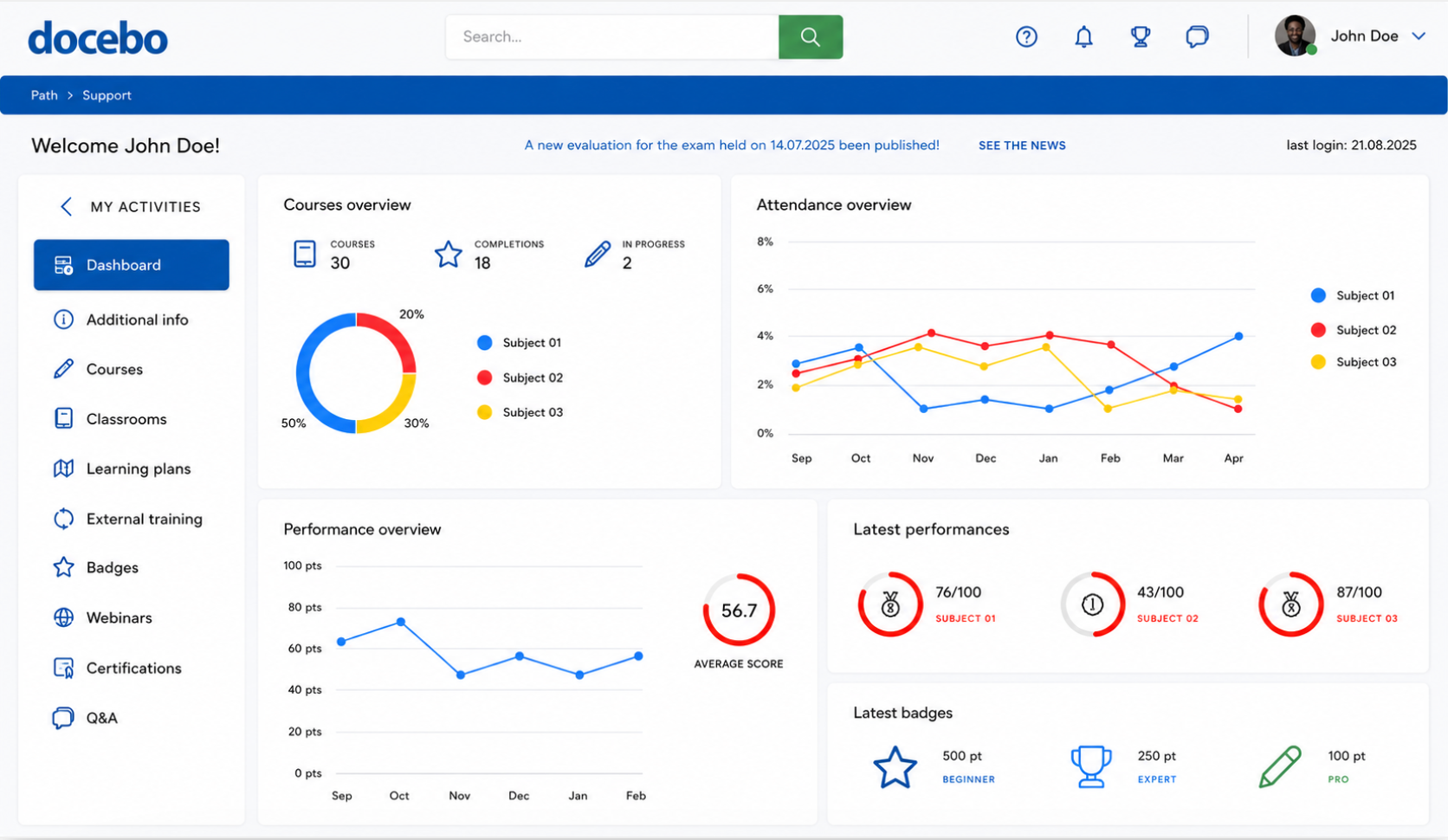
Docebo is an enterprise LMS for organizations managing learning across employees, customers, partners, and other external audiences. Its Extended Enterprise setup lets teams create separate learning environments with different branding, content, and administrative access.
It also supports learning plans, certifications, automated enrollments, and instructor-led or virtual training. Organizations provide the instructors and training content, while Docebo handles the learning infrastructure and administration.
Key Features
- Learning plans: Builds structured learning paths using e-learning and instructor-led courses.
- ILT and VILT management: Supports scheduling, attendance, materials, and learner progress for live and virtual sessions.
- Certification management: Handles certification expiry, renewal, retraining, and recurring requirements.
Pros
- Certification and retraining tools suit recurring compliance requirements
- Supports both digital and instructor-led training
- Administrative controls can be distributed across different business units or learner groups
Cons
- Setup can be time-consuming with admin tasks requiring extra steps
- Organizations need to provide their own instructors or facilitators for live programs
Why We Picked This
Docebo is a reasonable shortlist option for teams that already have instructors in place and need an LMS to manage training across employees, partners, and customers.
Pricing
Docebo provides custom enterprise pricing based on organizational requirements.
8. Valence
Best for: Always-on AI coaching for managers at scale
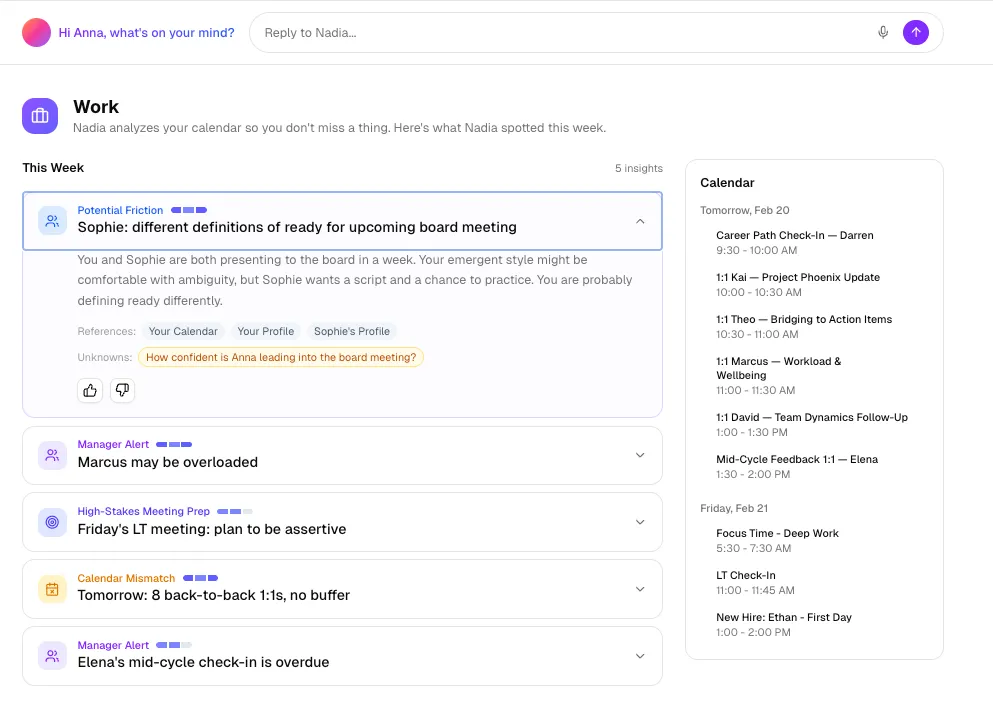
Valence is an AI-first coaching platform built around Nadia, an always-available AI coach for managers and employees. Nadia draws on context from calendars, team dynamics, company priorities, and past interactions to support day-to-day situations like difficult conversations, goal setting, and meeting preparation.
Unlike the human-led platforms on this list, coaching is delivered through AI. Valence also includes team diagnostics and guided conversation tools that help managers surface team issues and track shared commitments over time.
Key Features
- Calendar-aware coaching: Uses meeting and calendar context to surface preparation and guidance before important moments.
- Team diagnostics: Helps teams identify friction points and guides managers through structured conversations.
- Shared commitments: Lets teams set and track agreed actions after diagnostic exercises.
Pros
- Proactive check-ins support managers around upcoming workplace situations
- Mobile access makes the platform practical for frontline populations
- Company context can be incorporated into AI guidance
Cons
- No human coach is involved in the coaching experience
- The experience depends heavily on the organizational and employee context available to Nadia
Why We Picked This
Valence earns its spot as an AI-only coaching option for organizations seeking support throughout the workday.
Pricing
Valence provides custom enterprise pricing based on deployment requirements.
How to Choose the Right Group Training Software for Your Organization
Before rolling a platform out across the organization, run a small, structured pilot. It gives you a clearer view of whether the platform actually fits your L&D goals. Here's how to do it:
1. Start With One Cohort, Not the Whole Organization
Pick a single team or employee group rather than rolling the platform out company-wide. A focused pilot gives you a clearer view of whether the delivery model, coaching experience, and reporting meet your needs before you commit more budget.
2. Define the Skill Gap Before Comparing Vendors
Decide which capability you want to improve and how you'll measure success before evaluating platforms. That gives you a consistent way to compare vendors instead of relying on product demos or marketing claims.
3. Set a Fixed Pilot Timeline
Give the cohort enough time to complete the program, but keep the evaluation focused. A mid-program check-in can also help surface issues with coach matching, engagement, or adoption before the pilot ends.
4. Ask Vendors These Questions Directly
- How are coaches or facilitators matched to a cohort?
- What happens if the initial coach or facilitator isn't the right fit?
- Does reporting measure progress against defined goals or only participation and completion?
- How does pricing change as the program scales?
- Does the platform support SSO and integrate with your existing HR systems?
Judge the results against your original objective. The most important question isn't whether employees enjoyed the sessions. It's whether the capability you wanted to develop actually improved and whether the same approach can be repeated across other teams.
Bottom Line: Growthspace Is the Best Group Coaching Platform for Precision Skill Development
Most group coaching platforms either go broad, covering wellbeing and general leadership across a whole workforce, or lean fully into AI, trading a human coach for scale. That works when the goal is broad development. It doesn't work when leadership asks for proof that a specific skill gap has actually closed.
Growthspace runs small, expert-facilitated cohorts matched to a named capability, not a generic curriculum, and tracks progress against that skill from day one. That gives L&D teams a direct, measurable answer instead of a completion rate.
If you want to stop guessing whether a coaching program actually moved the metric leadership asked about, book a demo with Growthspace. We'll show you how organizations like Tim Hortons, TELUS Digital, PayPal, and Siemens use precision-matched cohorts to close real skill gaps.

Related Articles
.png)
.png)
Ready to turn insights into impact?