


When culture becomes your competitive edge
In an industry where margins are razor-thin and competition is fierce, Longo Brothers Fruit Market (Longo’s) has built something most grocery chains can't replicate: a culture so distinctive that customers choose them not just for what's on the shelves, but for how they're treated when they walk through the door.
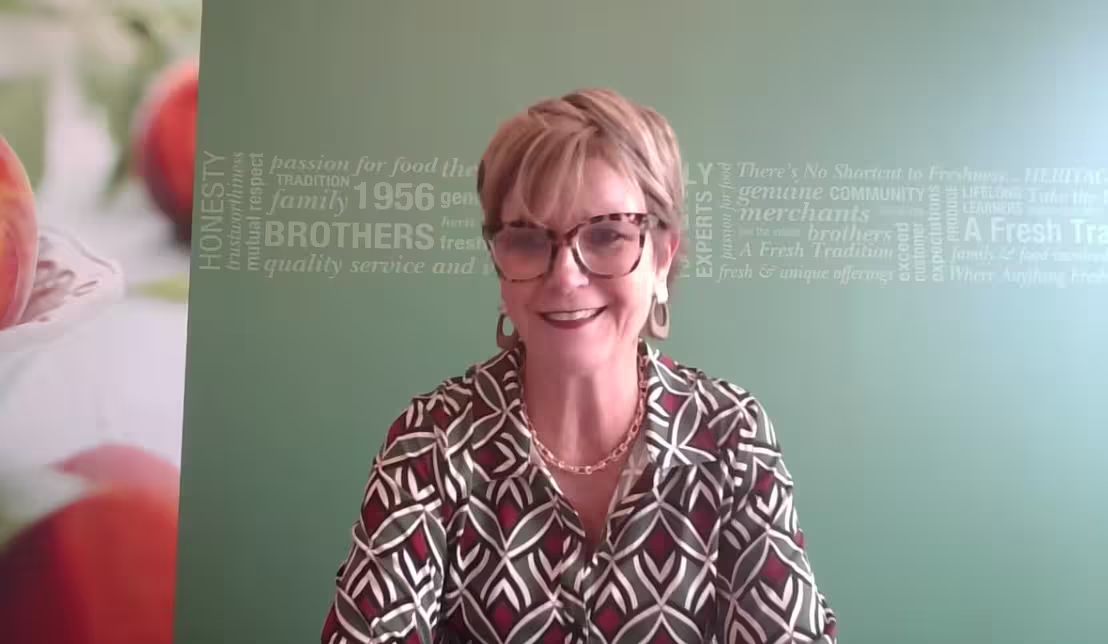
"Culture is not a poster. It's a differentiator," says Liz Volk, Chief Human Resources Officer at Longo's, who has spent two decades helping shape the people strategy at this Ontario-based grocer. With over 40 locations and 6,000 team members, Longo's is approaching its 70th anniversary—and the family-first philosophy that started with three brothers from Sicily in 1956 remains as central to the business today as it was then.
But sustaining culture through seven decades of growth, industry disruption, and a major partnership with a national chain requires more than good intentions. It demands intentional design, operational rigor, and a people development strategy that treats learning as a competitive necessity.
The blueprint: Treating you like family
When Longo's executive team sat down nearly 20 years ago to articulate what made them different, they landed on four words that would become their cultural north star: treating you like family.
"It's interesting because at some point the team was concerned that would come across as a soft culture," Volk explains. "But when you think about treating you like family, sometimes the toughest conversations you need to have are with family."
The principle guides everything from quality standards ("If you wouldn't serve this to your family at home, don't serve it to our guests") to service behaviors (team members walk customers to products, use umbrellas on rainy days, and help carry groceries to cars). These small acts, consistently delivered, create an emotional experience that influences buying decisions and builds fierce loyalty.
The philosophy applies not just to guests, but to vendors and team members as well. It's a comprehensive approach to stakeholder relationships that shapes daily decisions across the organization.
Making culture operational
Culture dies when it lives only in mission statements. At Longo's, it's embedded in operations through three mechanisms:
1. Recognition as a cultural tool
President Deb Craven—Longo's first non-family leader—personally reviews every guest comment that comes through loyalty programs and comment cards. She shares positive examples on the company's recognition platform, highlighting team members by name and connecting their actions to cultural values.
"Those stories get shared across the company and so people can see, oh wow, that's what treating you like family is. That's the type of behavior that we want to see," Volk notes.
2. Ritualized behaviors
The "Take Me There" program—where team members walk guests to products rather than pointing—has been company practice since the founding brothers ran a fruit stand on Yonge Street. It's not optional. It's how business gets done.
3. Storytelling that drives impact
The origin story of Longo's is frequently retold: Tommy Longo, working for a competitor, marked down produce that wouldn't last the weekend. His supervisor told him, "We pay you to work, not to think." Tommy quit and started his own business with a different principle: use your voglia—Italian for passion—to make decisions and deliver exceptional service.
"We use that founding story to say, we want you to do the opposite," says Volk. "Take a risk. Make those decisions."
Navigating change without losing your center
Over the past five years, Longo's has faced internal transformation and external pressure that would destabilize most organizations:
- Doubling distribution center capacity
- Opening new store locations
- Transitioning from private family ownership to partnership with publicly traded Sobeys
- Merging a 25-year e-commerce operation into Empire's platform
- Weathering public scrutiny as grocery chains became "the face of inflation" in Canada post-pandemic
- Managing team anxiety around tariffs and economic uncertainty
Through it all, Volk and her team used culture and values as the decision-making filter. "We always talk about, okay, when we're faced with something difficult, how does this fuel happier and healthier lives?" she explains, referencing the company's purpose statement.
When tariff concerns escalated, President Craven didn't wait for answers she didn't have. She recorded a video addressing team member worries head-on: Here's how it's going to play out in our business. We don't have all the answers. Here are the things we're doing. Here's how you can answer questions for the guests. And here's what we're thinking about for your families.
"I think it's just really using what we do every day in terms of our culture to navigate through a lot of that change and put yourself in the guests' shoes and our team members' shoes," Volk reflects.
Learning as competitive infrastructure
For the Longo brothers, growth wasn't about empire-building.
"Their founding intention was not just to grow the business for the sake of that," Volk explains. "The other part of their reason for growth was really to provide team members opportunities for growth. They said if we don't keep opening stores, people won't stay with us and they won't have a career with us."
That philosophy evolved into lifelong learning as a core organizational value—and learning programs as business infrastructure, not HR overhead.
The evolution of learning at Longo's
Twenty years ago, learning meant in-classroom training programs that gave leaders fundamentals in business and leadership, even partnering with a college to offer credits for team members without formal education.
Today, the approach is more nimble and personalized:
- Virtual and in-person programs provide foundational skills and leadership development
- On-the-job experiences build capability in real contexts
- Skill development—both one-on-one and group—solves real business problems while developing talent
"As much as we can, we're really trying to kind of tailor to the person and to their leader and tie it back to what are we seeing as some of the gaps?" says Volk. "Sometimes you get as much out of people by leveraging their strengths and kind of downplaying what isn't going to be a strength."
Development that solves business problems
With a lean L&D team ("we're quite scrappy," Volk admits), Longo's needed learning solutions that delivered both capability building and business outcomes. Enter Growthspace.
1:1 skill development: Democratizing leadership development
"One-on-one coaching is fantastic because it allows us to have greater reach," Volk explains. "Before, in an older model of how you would offer one-on-one coaching, it would be very, very expensive to do that. Whereas now we can actually have frontline leaders having the opportunity to have an executive coach, as well as all the way through to our VPs."
Group skill development: Building capability while solving real problems
Longo's uses group skill development with a clear mandate: there must be a business problem to solve, and development must happen concurrently.
To take a closer look, we compiled results from Longo’s deployment of group skill development in their organization. For Longo’s, an organization who had seen fast-evolving change and evolution amid external macroeconomic factors resulted in business priorities that required a sharp focus for group skill development cohorts on three key skills:
- Leading through change
- Goal setting and execution
- Alignment and ways of working
On a scale of 1-5, learners rated their ability to apply new skill development in their daily work at an average of 4.355.
“The smaller group allowed for all perspectives to be heard and made group consensus more efficient,” said one participant. Another participant found “hearing other ideas and perspectives in an open environment as well as practicing the models and skills in real time with open and honest feedback” invaluable to their day-to-day work.
Overall, participants walked away with more skills, confidence, and impact on the business’s bottom line:
- Collaborative learning: Valued open dialogue and teamwork in a structured, small-group setting.
- Facilitator impact: Appreciated guided reflection and new perspectives that deepened learning.
- Practical application: Gained actionable tools to strengthen accountability and team performance.
Case in Point: Redesigning the Tasting Experience
When Longo's wanted to elevate its in-store product tasting program—a critical touchpoint for the "treating you like family" experience—they recognized it was a cross-functional challenge requiring operations, supply chain, merchandising, marketing, and learning & development alignment.
Rather than launch a traditional project team, they used Growthspace's group coaching model with a specific outcome: create a unified playbook and aligned success metrics.
"The end product is this group needs to come up with a playbook and needs to come up with aligned metrics of success," Volk describes. "And hopefully through that process of coaching, doing group coaching together, they'll work better together."
The results have been substantial:
- Consistent tasting experiences across all locations
- Reduced friction and operational problems
- Improved team member-guest engagement
- Measurable lift in sales
- Positive guest feedback
- Stronger cross-functional collaboration
"It may look easy when we go into a store and see that somebody is demoing you the product, but there's a lot of things that have to happen and happen well," Volk notes. "The business is thrilled and wants to see us do more of that."
HR as business leadership
Volk's approach to HR is refreshingly pragmatic: "I think you need to think of yourself as really a business leader. And when you get to that level, you really need to be thinking about the business first."
Her most uncomfortable—and valuable—experience came after a decade at Longo's when she took a one-year secondment into operations.
"I felt like I was in a brand new organization. The operations, they speak a different language, they have their own acronyms," she recalls. Two critical insights emerged:
- The business is more complex than HR often realizes. "Sometimes when you're sitting in your role as an HR professional, you can wonder why they're not executing my programs exactly as I thought. But if you don't make them very practical... it's not necessarily going to get executed."
- Great design means nothing without operational fit. "When I got back into the HR seat, we started unpacking some of our programs and I was like, my goodness, no wonder some of these things don't work. Because when I was on the other end, I was frustrated by some of our programs."
Her advice for HR leaders is direct: "You can't really be a partner if you don't know how the business makes money. So starting from there: How does the business make money? What are the most important things to the business? And what are the objectives that the business is trying to accomplish?"
The Proof: Retention as a leading indicator
After 20 years, Volk points to one metric that tells the full story: "We've retained so many great, talented individuals and they're actually choosing us to have their career with us."
But it's not just retention—it's how people stay. "It's not just people staying and having long tenure, but they're staying, having long tenure and they're evolving with what the business needs are."
That's the signature of a learning culture that works: people don't just endure change, they grow through it.
Action steps for leaders
To build culture and capability as competitive advantages, Volk's experience suggests leaders should:
- Spend meaningful time in the business to understand real guest needs and frontline realities
- Link every learning activity to a clear operational or commercial objective—no development for development's sake
- Use stories to model expected behaviors and reinforce cultural standards consistently
- Strengthen cross-functional relationships to increase alignment and reduce organizational friction
- Personalize development to individual strengths so it feels practical and relevant, not generic
- Make culture operational, not aspirational—embed it in rituals, language, and daily decisions
The formula for organizational growth
Longo's proves that culture isn't soft—it's strategic. When lived consistently through stories, behaviors, and daily decisions, it becomes a moat competitors can't cross.
But culture alone isn't enough. It must be paired with practical people development that solves real business problems, builds cross-functional capability, and helps teams navigate constant change.
As Volk puts it: "I think what's really super important is partnering with the operations and really understanding what does the business need in order to be successful and achieve the results. And then weaving them into whatever learning and development opportunity that you have at the time."
That's the formula: culture as strategy, learning as infrastructure, and HR as business leadership.
After 70 years, Longo's isn't slowing down—they're building the next generation of leaders who will carry the family-first philosophy forward.
Resources
- Connect with Liz Volk on LinkedIn
- Learn more about Longo's
- Explore Growthspace for precision skill development at scale
Chapters
- 00:00 - Introduction to Longo’s and Liz Volk’s journey
- 02:31 - Longo's origin and values: How a small family fruit market shaped a lasting culture.
- 04:53 - Treating you like family: What the philosophy means in daily behaviou.
- 06:57 - Culture as a unique selling point: Why emotional experience differentiates Longo's.
- 14:43 - Navigating change with empathy: Supporting teams through industry pressure and public scrutiny.
- 19:24 - Evolution of the learning culture: Blending micro learning, coaching and practical skill building.
- 23:57 - Raising the bar on development: Using cross functional projects to solve real business problems.
- 29:49 - HR as business leadership: Why HR must understand how the business makes money.
- 33:04 - Sustaining culture and retention: Celebrating long term growth and the power of staying true to purpose.
Listen to the full episode of Skilled for more insights on building culture, developing talent, and leading through change.
Ready to turn insights into impact?






.png)
.png)