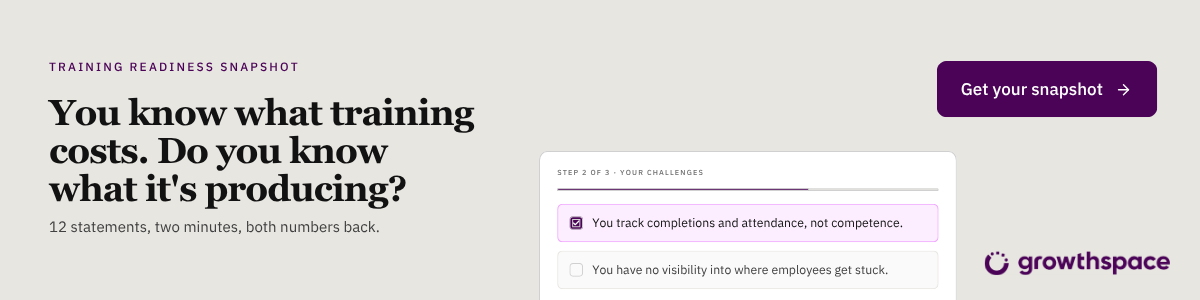
We recently published the Training Readiness Snapshot, a 2 minute assessment that gives training professionals a clear picture of where their program stands: what their training spend is likely buying them, and how ready that program actually is to make the most of it.
Building the assessment meant deciding what to actually check for. The harder question is what each item is actually telling you, and what the healthy version of that same moment looks like instead. Behind every one of these twelve is a real operating decision an organization has already made, whether it meant to or not. Here is what each one means, and what good looks like when you get it right.
Delivery friction
This category is about how training actually reaches people. When delivery depends on someone's schedule, three things tend to happen: training shows up late, it shows up unevenly, and it stops showing up entirely once things get busy.
Training only happens when someone schedules a session or course.
This is a supply problem wearing a training hat. The organization has plenty of demand for learning, but delivery only exists when someone puts it on a calendar. Good looks like training that's available the moment someone needs it, not gated behind a session date that may be weeks away.
New hires wait days or weeks for their first real coaching conversation.
Every day between "hired" and "first real conversation about the job" is a day of lower confidence and slower output. It usually isn't anyone's fault. It's just what happens when coaching depends on a manager or mentor finding a free hour. Good looks like a new hire getting a real, substantive conversation almost immediately, not whenever a calendar opens up.
Content that felt current at launch feels dated within a few months.
Content decay is rarely about quality. It's about ownership. Nobody's job is to keep it current, so it quietly goes stale while everyone assumes someone else is watching it. Good looks like content that updates continuously, tied to what's actually changing in the product, the process, or the market, rather than content that gets revisited once a year if at all.
A manager's calendar decides how much feedback or practice anyone gets.
LinkedIn's 2025 Workplace Learning Report found manager support for team development has been sliding, with the report noting that "dramatic drops in manager support for their teams point to widespread drains on manager time." That's not a manager problem. That's a structural one: if development quality is tied to how much slack a manager happens to have that week, most employees are getting an inconsistent experience by design. Good looks like feedback and practice that don't depend on a manager's bandwidth, because they're built into how the work happens.
Reach versus depth
This category is about a tradeoff most training programs never actually chose: reach, or depth, but rarely both. Usually because the person best equipped to teach something well is also the busiest person in the building.
Your top performers can't personally scale their time to reach everyone.
The best knowledge in the company is often trapped behind the calendar of two or three people. It's not that they're unwilling to teach. It's that there are only so many hours. Good looks like what your top performers know getting captured and made available broadly, not reserved for whoever manages to get time with them.
Live sessions cap how many employees get trained each quarter.
Reach ends up capped by room size and instructor availability, not by how many people actually need the training. That's a delivery constraint pretending to be a strategic decision. Good looks like reach that scales with headcount, not with how many live sessions can physically fit on the calendar.
The expertise that matters most lives in a handful of people's heads.
This is concentration risk, plain and simple. If those few people leave, get promoted, or just get busy, the expertise doesn't transfer with them, it disappears. Good looks like expertise that lives in a system the organization can draw on, not only in the memory of a few individuals.
You can't say with confidence who retained what, only who attended.
Attendance is an easy number to collect and a weak proxy for what actually happened. Knowing who showed up tells you almost nothing about who can now do the thing. Good looks like being able to say, with real confidence, who retained what, not just who occupied a seat.
Measurement gaps
This category is about whether training gets evaluated the way any other part of the business would be. Most programs settle for measuring effort because outcome data is harder to get. That tradeoff has a cost.
You track completions and attendance, not competence or readiness.
Completion tells you someone clicked through a module. It says nothing about whether they can do the job better because of it. Good looks like measurement that answers "can they do this now," not just "did they finish it."
You have no visibility into where employees actually get stuck.
Without that visibility, problems get discovered anecdotally, usually after they've already cost something, rather than caught early through actual data. Good looks like knowing precisely where people struggle, so gaps get addressed before they turn into performance or retention issues.
Enablement rate, retention, and ramp speed aren't reviewed as program numbers.
Every other function in the business gets reviewed against numbers that matter to leadership. Training often doesn't, and that's a big part of why it doesn't get resourced like the other functions do. Good looks like these numbers showing up in the same kinds of reviews as pipeline, churn, or product adoption.
You can't give leadership a confident ROI number for your training spend.
The same LinkedIn report put it plainly: "learning and talent development leaders struggle to articulate the value of their work." Without outcome data connecting training to something leadership already cares about, that spend is vulnerable in every budget conversation. Good looks like a number you can defend, backed by data that actually ties training to results.
Where this leaves you
None of these are about doing more training. They're about whether training behaves like a system that reaches people reliably, distributes what your best people know, and proves it worked, or whether it depends on calendars, memory, and good intentions. ExpertX was built around exactly that gap: making expertise available on demand, in whatever format fits the moment, without asking your best people to personally show up every time someone needs help.
Take the survey today, 2 minutes, great snapshot into what you may be missing:

Related Articles
.png)
.png)




Ready to turn insights into impact?